Showing posts with label knitting. Show all posts

Sunday, March 1, 2015

What's with this Wool?


Have you ever wondered why sheep don’t shrink when they get wet?  They are ‘wearing’ wool, after all.  And, when we wash the wool we wear, it shrinks, right? 
 
Technically, wool does not actually shrink, it felts. Wool fibers have a cuticle layer and scales much like human hair, although the scales on human hair are much flatter (remember all those hair conditioner commercials?). When wool is washed, under certain conditions, the raised scales of that cuticle layer catch on to each other, which begins the felting process. 

The fibers in the fleece on a sheep are all growing out of the follicles in the same direction, and at a similar rate.  This means that the cuticle scales are all pointed in the same direction (much like the teeth on a saw blade), and they don’t catch, or lock, on to each other, even if wet.


Roving

When fleece is shorn, the processing stages cause the fibers’ natural alignment to get messed up.  As it is cleaned (called scouring) the individual fibers in the fleece no longer line up ‘tip to base’ as they do on the sheep.  They get all jumbled up in various dimensions and directions.  ‘Carding’ realigns the fibers into a parallel arrangement for spinning (roving into yarn/thread) but the fibers are not necessarily ‘tip to base’, so the scales will still catch onto each other.


Drop spinning
 
When the fibers are spun they come in close contact with each other, and that interlocking nature of the scales helps keep the yarn together.  Felting usually occurs in the presence of heat, water, and agitation which acts as a ratchet to tighten that contact between the fibers in the yarn, and then the yarns in the fabrics.  When the wool fabric gets wet and then dries, the fibers that point in various directions latch on to each other and lock closer together, meaning all the strands of wool pull together tighter than before, and your wool sweater shrinks up! With enough heat, water and agitation the fibers will interlock tight enough to form a solid mat.
 
The other factor that helps sheep keep their fleece from shrinking is lanolin, an oily-waxy substance they produce naturally. (Lanolin is used in many products designed to beautify, protect and treat human skin.) The lanolin keeps the scaly wool fibers slick and helps prevent them from locking together, and it is removed from the fleece during the cleaning/scouring process.  Shrink-proofing is a chemical treatment that uses chlorine to ‘burn’ off the scales.  It doesn’t entirely remove them, but it does lessen their profile.  The fibers are then coated with a resin to smooth them further.  This allows the wool to be machine washed without shrinking, or felting.

Before and after felting

We use wool yarns (new) that are NOT shrink-proofed to make Snooter-doots.  We want the yarns we use to felt as much as possible to create a solid shell in the shape of the critter we are looking for.  Different brands, styles, and colors of wool yarn felt differently.  We’ll take a look at that next time. We think wool is quite magical, and since it's a sustainable, renewable resource, it's the perfect material to make Snooter-doots with.
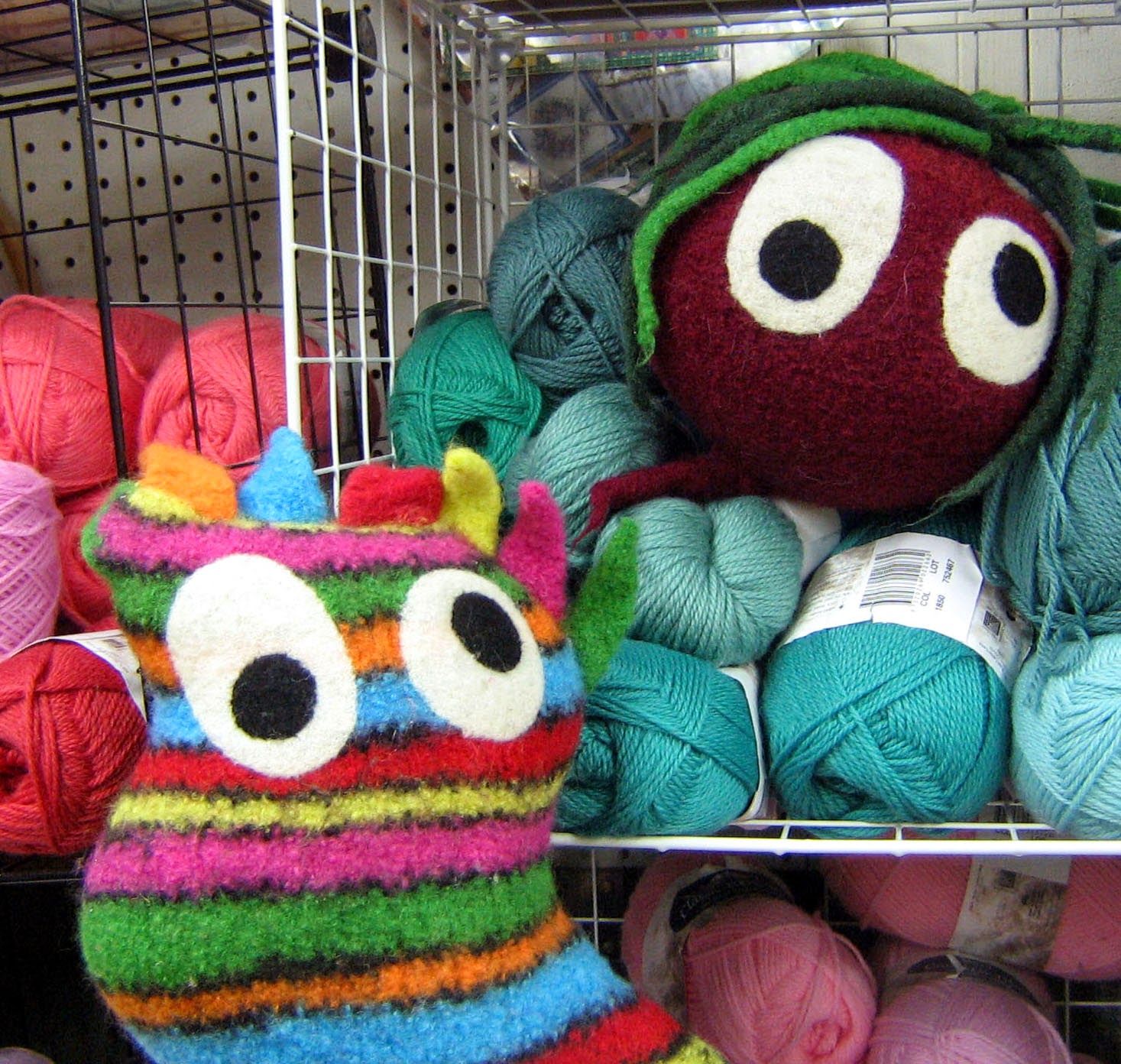
 
Lennie & Bruce inspect our yarn stash.


Tuesday, January 24, 2012

"Mama Snooter, where do Snooter-doots come from?"

Well, Virginia, that’s a pretty long story. Let’s start here:

I knit each Snooter-doot to-shape first. It is a mostly a series of increases and decreases in just the knit (garter) and purl stitches. I use 100% wool, or wool/alpaca/llama, yarn. I buy it new rather than using upcycled sweaters because after all that knitting I need to be sure it will actually felt well. (We’ll discuss wool & felting later.)
Before & after felting


I’ve got a pretty good understanding of my basic proportions now, and have standardized most of my patterns, so I can usually ‘guess-timate’ what it may take to produce a new critter if it is based on an existing shape. There’s a wide range of shrinkage to account for when you are felting wool. If it’s an entirely new Snooter-doot shape, it usually takes at least three or four prototypes to get it just right. (I’ll tell you all about inspiration another time.)

I run what I call ‘blanks’ on my knitting machine. That produces a straight ‘tube’ that I then finish by hand with all the shaping it takes to create each different softie. Some of our Snooter-doot friends must be knit entirely by hand, like Carl Carrot, Morrie Monster, and our newest BFFs, the Hearts. (I can show you some knitting basics later, if you are interested.)

Once all the knitting is done, wings and fins and greens attached, everybody takes a hot, bumpy ride in the washing machine. Sometimes it takes several ‘rides’ to get the felting done just right. When it is, they all sit out to dry on their special drying rack in the basement.

Now comes the fun part! When they are all completely dry, I stuff ‘em! I use polyester fiberfill, and pack it quite tightly so they will hold their shapes well, but they are still called ‘softies’ even though they are so firm. Then, I attach their whimsical, wonky eyes – that’s what makes a Snooter-doot a Snooter-doot, you know! I do that by ‘needle-felting’ (I’ll show you how that works later).


Needle-felting the eyes

Once their eyes are securely in place, I determine what their name will be. Sometimes they tell me; sometimes I have ideas of my own to suggest. That day becomes their official birthday, and my softies are then ready for adoption into their forever families.

 
That, Virginia, is where Snooter-doots come from.

Saturday, November 26, 2011

Gardenin' with Gertie ~ Using Stone in the Landscape


Goo' Day!  Gertie here again.  I asked my good friend, and stone expert, Lloyd Glasscock, with Looking Glass Design, to share some insights about using stone in the landscape (one of my favorite techniques).  Here's what he had to say. 

‘Using stone in the landscape’…sounds daunting doesn’t it? To some people it conjures up images of castle-like retaining walls or plazas of flagstone, something not always feasible for the urban garden. Others simply can’t picture how to use stone, let alone why.

In the ‘body’ of a landscape I like to think of stone as the ‘bones’. Whether you’re creating pathways, patios, walls or
fountains, stone provides structure and defines space in ways plant material can’t. It can provide a focal point or serve as a guide through the garden. Once installed it generally requires little or no maintenance and enhances the landscape.

When selecting stone for the garden, first choose the function and then the form. Many types of stone can be used for a variety of purposes, for instance; a natural stone walkway can be created using flagstone or thicker ledge stone (wall stones).

Choosing stone color can be more challenging. Flagstone and ‘accent stones’ (especially those used in water features) may change color over time as garden debris (leaves) or moss and algae settle in. Sweeping the stone areas usually helps, but the stone will likely still darken a bit. For walls (ledge stone) this is less an issue.

Often when presenting a design to a client there will be symbols for stones in the garden beds. We’re blessed with an abundance of available plant varieties in the Pacific Northwest; I think of these stones as ‘breaking up the green’. Using a small grouping of ledge stone or a stone basin in the beds can accent plant materials by providing a backdrop to let them stand out.

There are many simple, practical and/or fun ways to use stone in the landscape. Visiting a local supplier of stone products before or during the design process of the garden or project can familiarize you with the many different products available and their usage. Good local resources are Marenakos Rock Center (Issaquah), Clearview Stone (Snohomish) and Pacific Stone Co. (Everett).

Lloyd Glasscock, CPH
Looking Glass Design
www.lookingglass-design.co

Tuesday, September 13, 2011

Traveling with your Snooter-doot


Snooter-doots like to travel. Lennie and Bruce have made it their goal to see as many, or more, sites than the Travelocity ‘Traveling Gnome’.


They’re off to a good start. The boys went to the Half Moon Bay Pumpkin Festival in California last year with Patty Pumpkin and the rest of the gang, and are looking forward to their trip again this October.


And, they’ve been all over Washington State, via the various festivals and art-fairs we’ve participated in. They’ve met lots of friendly SnooterFolk along the way


– often getting a photo with them.

Why should we travel with our Snooter-doot? Consider these thoughts:


• Since they have no mouths, they won’t be asking “Are we there yet?” incessantly.


• They don’t get carsick, so they won’t throw-up all over the back seat. Keep them inside the car windows, though; they don’t make good hood ornaments.
• Since Snooter-doots have no hands, they won’t lose their mittens.

• Snooter-doots are knit from the finest wool yarn and, when wet, will still keep you warm. Although, we do admit, they’ll smell a bit like a wet dog.

• They can act as neck pillows on long airline flights – saving you the outrageous costs of purchasing one of the airline pillows.


• Handcrafted and felted, Snooter-doots are very sturdy, so they won’t break if packed tightly in a suitcase.


• They can be a great conversation piece while being frisked by the TSA.

• Snooter-doots are warm and fuzzy, and a great companion for cranky young’uns to cuddle with.

• Since they are pretty much all eyes, they love to see all the sites. And they provide just the right perspective when placed near serious or overwhelmingly large vistas for those commemorative photos.


• For you single’s out there, they offer a refreshing ‘pick-up line’ - “Hey, wanna come back to my place to meet my Snooter-doot?” After all, as felted art-dolls, they’ll class up the joint.

• And, Snooter-doots just make you smile. Don’t we all need that these days?

So, when you’re on the road again, remember to bring your Snooter-doot.

Keep on truckin' (and send us some of YOUR photos)!

Friday, September 2, 2011

'BRUCE's BOOKS' Club Reviews - Vol 1


BIG KID'S DEPARTMENT


submitted by: Jacqui A

My favorite book receives that accolade for two reasons. First, it's a story that causes me to stop and think about life every time I read it. Moreover, I've probably reread it about 100 times. The second reason it's one of my favorites, is that one of my best long-term friends gave it to me, even though she misspelled my name when she wrote, "To Jackie (sic), Create a wonderful life for yourself up there!" as I headed off to Alaska.

Written by Richard Bach, Illusions, The Adventures of a Reluctant Messiah, presents Donald Shimoda, a modern day Messiah who walks away from adoring crowds to open the eyes and mind of the main character, Richard. Learning the lessons from the mysterious "Messiah's Handbook," Richard, too, becomes a crowd attracting Messiah who writes about the lessons in this book.

After reading this book, your mind turns over questions such as, what is reality? Is it just a perception or something else? Why are we on earth and what are we supposed to do? How do we know if we've done it? If you have the answers, you are a Messiah. If you don't have the answers, you're still a Messiah. Think about it. Read the book, it may help.

~ ~ ~ ~ ~ ~ ~ ~ ~ ~ ~ ~ ~ ~ ~ ~ ~ ~ ~ ~ ~ ~ ~

submitted by: Popperfisk

Hidden Mickey’s: A Field Guide to Walt Disney World’s Best Kept Secret, by Dr. Steven Barrett

Headed to Disney World anytime soon? One particularly fun thing to do while you are there is to search for Hidden Mickey’s. There are over 800 images of Mickey Mouse that the Disney Designers and Imagineers have cleverly placed through out the World… they may be woven into carpets, pressed in to concrete walkways, painted into murals – just about anywhere you can think of .

This book is the quintessential guide to their locations and is organized into 6 different Scavenger Hunts complete with clues, hints and points – the harder they are to find the more points you can score! There is also a version of the book available for Disneyland, and there is an Ap available for your IPhone.

Dr. Barrett is also a regular Blogger on the Disney insider’s website AllEars.net, where he frequently posts about new Hidden Mickey’s and ones that have disappeared or moved – something those whacky Imagineers love to do all the time! Enjoy!

~ ~ ~ ~ ~ ~ ~ ~ ~ ~ ~ ~ ~ ~ ~ ~ ~ ~ ~ ~ ~ ~ ~ ~

NOT-SO-BIG KID'S DEPARTMENT


submitted by: Mama Snooter

Time of Wonder, by Robert McCloskey

This ‘1958 Caldecott Medal’ winning book is one of my all-time childhood favorites, and is still relevant today. The illustrations are calm yet intriguing, in misty tones of watercolor wash – until the big winds hit the little island this family of four vacations on.

The story describes the islands around Penobscot Bay, Maine, and all that the folks who live there love about the sea, the shore, and the surrounding forests. Their island life is challenged by a coming hurricane, and the excitement of their preparations is profound. The best part is the wonder of exploring the UPPER limbs, trunks, and root systems of giant trees that were toppled by the storm. The girls find such treasures!

It all wraps up into the story of a never-to-be forgotten summer for two young girls, with boating and swimming and weather-worn rocks to climb on, and a close-knit family who takes care of each other. I just want to climb into the pictures and be with them!

I am so taken by this book that my ‘bucket list’ has always had a trip to Maine as one of my top three wishes. That wish was granted not too long ago, when my daughter was attending college in Boston. She arranged for a tour of Stonington, Maine, where she rented an old lobster boat and captain to tour the very same islands described by McCloskey. It was a dream come true! And, the lobster dinner afterwards, wasn’t bad either!

Robert McCloskey also wrote and illustrated: Make Way for Ducklings, Blueberries for Sal, One Morning in Main, Homer Price, and Lentil.
~ ~ ~ ~ ~ ~ ~ ~ ~ ~ ~ ~ ~ ~ ~ ~ ~ ~ ~ ~ ~ ~

Wednesday, August 24, 2011

Where do Snooter-doots come from?

Rumors of their existence began circulating again about 27 years ago, but they were never seen. Until now. So, where do Snooter-doots come from? When she was barely five years old, young Miss Tarah told her mother a fantasical story about the Snooter-doots and their friends Popipity-The Squirrel, Digdirt -The Man, and the Ol' Bix. Her mother loved the story, but had no idea where Miss Tarah got such notions, nor did she understand their significance. But, she tucked the story away in her mental library, and promised herself she would do something with it some day. Over the years Tarah's mother toiled away at her various jobs, some she enjoyed more than others. In her heart, though, she knew she really just wanted to 'make things'. There was an artist hiding within her somewhere. And, always she was a friend to the animals, domestic and wild, and had great respect and admiration for Mother Nature and all her wonders. Bubba Squirrel lived in Tarah's mother's neighborhood. Since she worked from home at the time, Bubba became quite comfortable around her, and relied on Tarah's mother to keep the feeder full of his favorite goodies. Which she did. On one of his many travels Bubba met Popipity-The Squirrel. Bubba told him of this particularly animal-friendly and creative HumanFolk that he knew back home, and suggested that she could act as the Snooter-doots' new ambassador. Many, many years ago John Strong, the farmer, (aka, Digdirt, The Man) was their link to the HumanFolk, but they lost his alliance when his beautiful and productive farm was pillaged for industry. The Snooter-doots were heartbroken, and vowed to remain enigmatice forever. After great debate, the Ol' Bix (the wise old crone), whom they respected greatly, convinced the Snooter-doots that HumanFolk were actually thinking carefully about their environment, its creatures, and their care again. So, they all agreed it was safe to reveal themselves and be known once more.
And, here they are!!
Welcome, Snooter-doots!

Tuesday, August 16, 2011

Travis & Jig's Worldly Adventures

We'd like you to meet our Guest Blogger, young Master Travis. He has agreed to share his virtual travels around the world with all of us here in lil' ol' Snooterville Junction.
Hi-ya! My name is Travis, and this is Jig, my awesome dragon-tadpole Snooter-Doot! Thanks to the Snooter-Doot website, I can tell all of you about our expedition around the world!
I recently went down to Alki Beach, in West Seattle, to watch the pirates land, and I found a special Snooter-Doot, named Cap’n J. Fishee, the pirate’s companion. Apparently his right eye was ripped off by a black and white dog named Lucy, so he wears an eye patch in its place.
I also went to the Street Fair that was exclusive to Saturday and Sunday and, guess what? I found a Snooter-Doot booth with Mama Snooter running it! That’s when I learned that Jig wasn’t the only dragon-tadpole Snooter-Doot! At the end of the day we got our passports!
So we’ll see you next time in Asia’s Japan!

Thursday, August 11, 2011

The Creative Process

Lennie and Bruce Beet were discussing the creative process recently, over a warm cup'a Joe. Snooter-doots are the perfect example of originality and inspiration. Mama Snooter wanted to make a fun, durable toy for her grand-dog, and, as she was already knitting and felting warm hats and caps, she pulled out some left over yarn and started to knit, free-form.
The results were the origin of what is now the phenomenon called Snooter-doots, whimsical and unique, handcrafted, art-dolls of felted wool. They have morphed a bit from that original creation (which, by the way, the grand-dog loved!) into soft-sculpture critters with tons of personality. Snooter-doots are now spreading joy and whimsy throughout the nation when 'adopted' by their new forever-families. They are even named with birthdays, all ready to go!
Lennie and Bruce find it interesting to consider where creative inspiration comes from. True artists find their muse in many places. Snooter-doots are inspired by nature. Mama Snooter draws from her horticultural background, love of the outdoors and food, through a system of 'what if's'. She designs and develops her own ideas into loveable characters that have become quite collectible. Strict adherence to the artist's creed, 'thou shall not copy', results in unique and original pieces that bring long-lasting joy and pride to their owners.
Patrons can best support true and original artistic concepts by talking to the artist about where their inspiration comes from and how they make their product. We have been contacted by several SnooterFolk who saw product recently they thought looked like Snooter-doots, but wasn't. Look-alikes are not original artistic concepts, and do nothing to enhance a person's collection. Accept only the best, the real McCoy, from a true artist.
Snooter-doots are handcrafted in Seattle, WA. They are available online at http://www.snooter-doots.com/ and at many fine gift shops thoughout the Pacific Northwest. You can also 'adopt' them directly at local arts/crafts fairs and festivals. Follow our adventures on Facebook, Lennie and Bruce would love to meet you!
Happy Snooterin'!