Sunday, March 1, 2015

What's with this Wool?


Have you ever wondered why sheep don’t shrink when they get wet?  They are ‘wearing’ wool, after all.  And, when we wash the wool we wear, it shrinks, right? 
 
Technically, wool does not actually shrink, it felts. Wool fibers have a cuticle layer and scales much like human hair, although the scales on human hair are much flatter (remember all those hair conditioner commercials?). When wool is washed, under certain conditions, the raised scales of that cuticle layer catch on to each other, which begins the felting process. 

The fibers in the fleece on a sheep are all growing out of the follicles in the same direction, and at a similar rate.  This means that the cuticle scales are all pointed in the same direction (much like the teeth on a saw blade), and they don’t catch, or lock, on to each other, even if wet.


Roving

When fleece is shorn, the processing stages cause the fibers’ natural alignment to get messed up.  As it is cleaned (called scouring) the individual fibers in the fleece no longer line up ‘tip to base’ as they do on the sheep.  They get all jumbled up in various dimensions and directions.  ‘Carding’ realigns the fibers into a parallel arrangement for spinning (roving into yarn/thread) but the fibers are not necessarily ‘tip to base’, so the scales will still catch onto each other.


Drop spinning
 
When the fibers are spun they come in close contact with each other, and that interlocking nature of the scales helps keep the yarn together.  Felting usually occurs in the presence of heat, water, and agitation which acts as a ratchet to tighten that contact between the fibers in the yarn, and then the yarns in the fabrics.  When the wool fabric gets wet and then dries, the fibers that point in various directions latch on to each other and lock closer together, meaning all the strands of wool pull together tighter than before, and your wool sweater shrinks up! With enough heat, water and agitation the fibers will interlock tight enough to form a solid mat.
 
The other factor that helps sheep keep their fleece from shrinking is lanolin, an oily-waxy substance they produce naturally. (Lanolin is used in many products designed to beautify, protect and treat human skin.) The lanolin keeps the scaly wool fibers slick and helps prevent them from locking together, and it is removed from the fleece during the cleaning/scouring process.  Shrink-proofing is a chemical treatment that uses chlorine to ‘burn’ off the scales.  It doesn’t entirely remove them, but it does lessen their profile.  The fibers are then coated with a resin to smooth them further.  This allows the wool to be machine washed without shrinking, or felting.

Before and after felting

We use wool yarns (new) that are NOT shrink-proofed to make Snooter-doots.  We want the yarns we use to felt as much as possible to create a solid shell in the shape of the critter we are looking for.  Different brands, styles, and colors of wool yarn felt differently.  We’ll take a look at that next time. We think wool is quite magical, and since it's a sustainable, renewable resource, it's the perfect material to make Snooter-doots with.
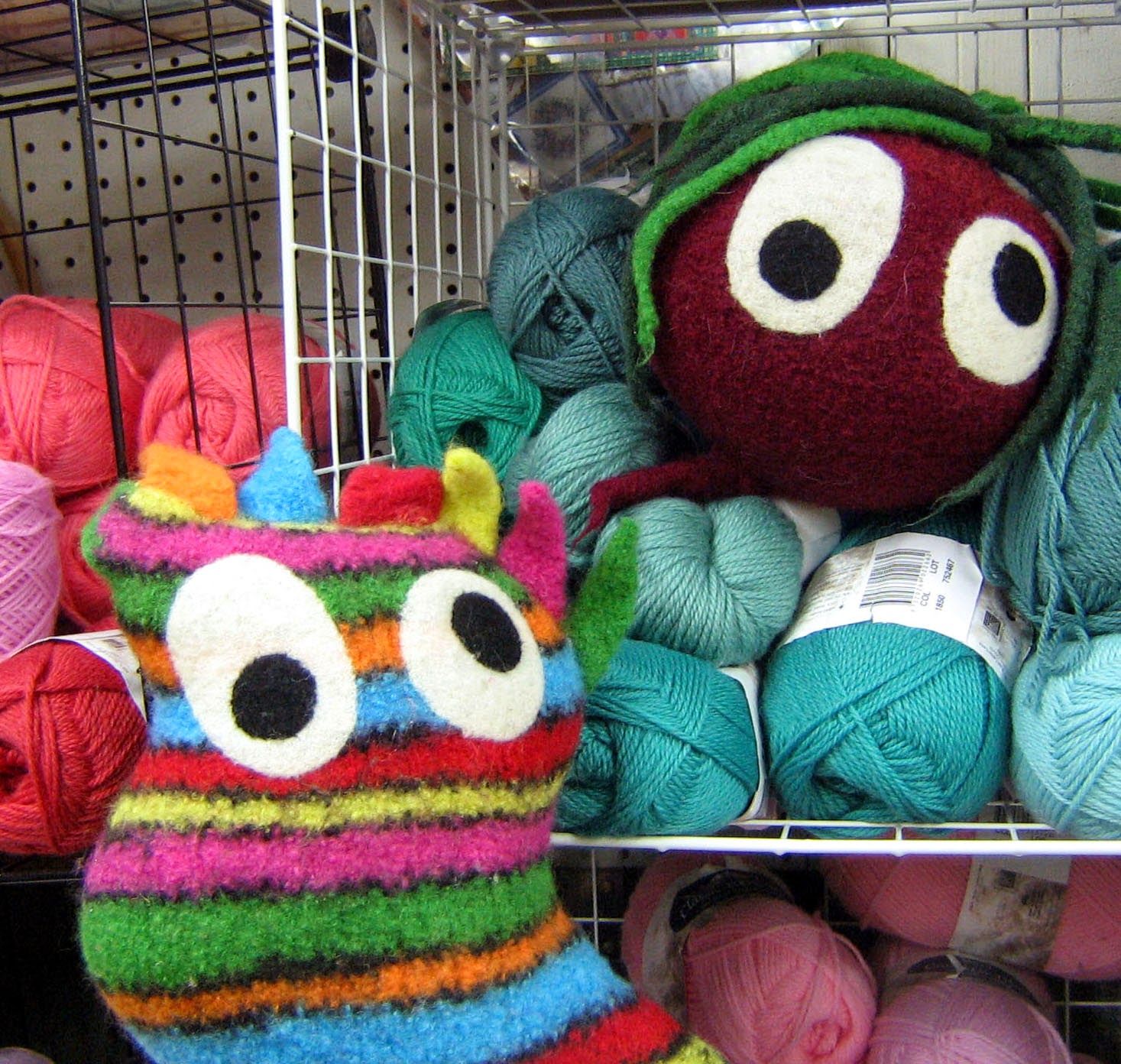
 
Lennie & Bruce inspect our yarn stash.


Monday, February 27, 2012

Meet the Snooter-doots!

Rumors of their existence started circulating about 25 years ago, but they were never seen. Until now. Let's meet some Snooter-doots!


Pete and Repete,Two-Peas-in-a-Pod:
As the older twin, Pete usually did things first. Repete often copied him, which irritated Pete greatly. After a long talk with the Ol’ Bix, Pete realized that Repete was just eager to be as cool as Pete was. So, Pete changed his attitude and accepted the compliment. They are now as close as, well, two-peas-in-a-pod.


Beemer, the Bumblebee:
Beemer thought of himself as the ‘Big Bee on the Block’. As a worker-bee his specialized job was to track down the best fields of blooming flowers, which he thought to be the MOST important position in the hive. Queen Bee became a bit concerned about his attitude so she asked the Ol’ Bix to have a chat with him. When she did, Beemer realized that EVERY job is important and the hive survives because they all work together like a well-tuned German sports car.


Starla, the Starfish:
Everyone in Starla’s tidepool thought she was a little ditsy because she was always staring at the moon. They teased her for being a day-dreamer and thought her to be lazy. That began to hurt Starla’s feelings. When she asked the Ol’ Bix what to do, the Ol’ Bix advised her to remember that the most successful Snooter-Doots (and HumanFolk too) know that you should aim for the moon ‘cause even if you miss, you will land among the stars. Starla liked that!


Ralph, the Hand Puppet:
Dave loved to talk. Talk, talk, talk. Snooterville Junction folks thought it to be more like “blah, blah, blah’, as he didn’t seem to care what he said, as long as he got to talk. The Ol’ Bix took him aside one day and, when she could get a word in edgewise, she cautioned him to think more carefully about what he said before he opened his mouth. Luckily for all of us, he took her advise.


We're all looking for good homes; you can adopt us at www.snooter-doots.com !

Tuesday, January 24, 2012

"Mama Snooter, where do Snooter-doots come from?"

Well, Virginia, that’s a pretty long story. Let’s start here:

I knit each Snooter-doot to-shape first. It is a mostly a series of increases and decreases in just the knit (garter) and purl stitches. I use 100% wool, or wool/alpaca/llama, yarn. I buy it new rather than using upcycled sweaters because after all that knitting I need to be sure it will actually felt well. (We’ll discuss wool & felting later.)
Before & after felting


I’ve got a pretty good understanding of my basic proportions now, and have standardized most of my patterns, so I can usually ‘guess-timate’ what it may take to produce a new critter if it is based on an existing shape. There’s a wide range of shrinkage to account for when you are felting wool. If it’s an entirely new Snooter-doot shape, it usually takes at least three or four prototypes to get it just right. (I’ll tell you all about inspiration another time.)

I run what I call ‘blanks’ on my knitting machine. That produces a straight ‘tube’ that I then finish by hand with all the shaping it takes to create each different softie. Some of our Snooter-doot friends must be knit entirely by hand, like Carl Carrot, Morrie Monster, and our newest BFFs, the Hearts. (I can show you some knitting basics later, if you are interested.)

Once all the knitting is done, wings and fins and greens attached, everybody takes a hot, bumpy ride in the washing machine. Sometimes it takes several ‘rides’ to get the felting done just right. When it is, they all sit out to dry on their special drying rack in the basement.

Now comes the fun part! When they are all completely dry, I stuff ‘em! I use polyester fiberfill, and pack it quite tightly so they will hold their shapes well, but they are still called ‘softies’ even though they are so firm. Then, I attach their whimsical, wonky eyes – that’s what makes a Snooter-doot a Snooter-doot, you know! I do that by ‘needle-felting’ (I’ll show you how that works later).


Needle-felting the eyes

Once their eyes are securely in place, I determine what their name will be. Sometimes they tell me; sometimes I have ideas of my own to suggest. That day becomes their official birthday, and my softies are then ready for adoption into their forever families.

 
That, Virginia, is where Snooter-doots come from.

Saturday, November 26, 2011

Gardenin' with Gertie ~ Using Stone in the Landscape


Goo' Day!  Gertie here again.  I asked my good friend, and stone expert, Lloyd Glasscock, with Looking Glass Design, to share some insights about using stone in the landscape (one of my favorite techniques).  Here's what he had to say. 

‘Using stone in the landscape’…sounds daunting doesn’t it? To some people it conjures up images of castle-like retaining walls or plazas of flagstone, something not always feasible for the urban garden. Others simply can’t picture how to use stone, let alone why.

In the ‘body’ of a landscape I like to think of stone as the ‘bones’. Whether you’re creating pathways, patios, walls or
fountains, stone provides structure and defines space in ways plant material can’t. It can provide a focal point or serve as a guide through the garden. Once installed it generally requires little or no maintenance and enhances the landscape.

When selecting stone for the garden, first choose the function and then the form. Many types of stone can be used for a variety of purposes, for instance; a natural stone walkway can be created using flagstone or thicker ledge stone (wall stones).

Choosing stone color can be more challenging. Flagstone and ‘accent stones’ (especially those used in water features) may change color over time as garden debris (leaves) or moss and algae settle in. Sweeping the stone areas usually helps, but the stone will likely still darken a bit. For walls (ledge stone) this is less an issue.

Often when presenting a design to a client there will be symbols for stones in the garden beds. We’re blessed with an abundance of available plant varieties in the Pacific Northwest; I think of these stones as ‘breaking up the green’. Using a small grouping of ledge stone or a stone basin in the beds can accent plant materials by providing a backdrop to let them stand out.

There are many simple, practical and/or fun ways to use stone in the landscape. Visiting a local supplier of stone products before or during the design process of the garden or project can familiarize you with the many different products available and their usage. Good local resources are Marenakos Rock Center (Issaquah), Clearview Stone (Snohomish) and Pacific Stone Co. (Everett).

Lloyd Glasscock, CPH
Looking Glass Design
www.lookingglass-design.co

Thursday, November 10, 2011

Gardenin' with Gertie - Fall Cleaning

Goo’day all, Gertie Geoduck here! I’ve got another gardenin’ thought to share with you  - fall cleaning is for gardens, while spring cleaning is for our homes.


We’ve had our first serious frost here in Snooterville Junction. That signals deciduous trees and shrubs to ‘head south for the winter’, well, to their roots any way. As these plants shift sugars and energy down into their root systems to overwinter, their leaves turn color and fall off. I look forward to seeing Mother Nature’s brilliance every year.


This also sends a signal to us gardenin’ geeks – time for ‘fall cleaning’. If there are any plants that you have recurring pest (disease or insect) issues with, you can reduce that issue by cleaning up any/all leaf and twig debris from under and around that plant. Pick it up now, and dispose of it.


Here in S-J we have garden waste collection, and, most of our garden ‘goodies’ go to a composting company where their process ‘cooks’ the compost to the point that most pathogens and weed seeds are deactivated. Although I have my own compost bin, I try to put only ‘clean’ clippings and material in it, as I can’t guarantee that there is enough consistent heat within the pile to really ‘cook’ things. Either way, we can then use that nutritious compost to fortify our planting beds next spring – what a Snooter-abulous way to recycle and reuse!


Miss Mary Jane-cat agrees that fall cleaning in the garden gets us a great head-start to a Snooter-ific spring (and she is more than happy to supervise)!


Happy Snooter-gardenin’!

Friday, October 28, 2011

Gardenin' with Gertie - Fall is for Planting


Goo’day all, Gertie Geoduck here!  My Snooterville Junction neighbors seem to think I know a thing or two about gardening and have asked me to share the ‘wealth’, or at least some of my tips and techniques. So, I’ve finally agreed to contribute to the Snooter-doin’s blog somewhat regularly, just in case you’re interested too.


Fall has fallen, and winter is not too far away. This is a great time to plant trees and shrubs – almost better than spring! Why, you ask? Plant roots grow anytime soil temperatures are 40 degrees or above. In the fall, our soils here in the PNW are still warm enough from the heat (however so briefly) of the summer, AND, we have the benefit of our infamous PNW rain, which provides natural (and free) irrigation.


During the winter months, the root systems of fall-planted material develop and become established. Then, when spring does return (sometimes later than never), those well-developed root-systems can support and take advantage of a full surge of spring growth. Plants with well developed root systems are better able to manage the stresses of summer heat and drought. There is also potentially less stress caused by insect and disease pest issues during the fall and into the cooler winter months.

The best time to plant in the fall is roughly six weeks before the first hard frost, which does not always correlate here in Snooterville Junction with the autumnal equinox of late September. It is also important to buy healthy plants. Get to know your local, independent garden center or nursery. You’ll most often get better service from their professional and knowledgeable (and often certified) staff while the prices are still quite competitive. Another benefit to fall planting is that you can get some Snooter-dooper deals at those local nurseries and garden centers as they are rotating inventory and making way for holiday displays.

There’s so much to share, I’m just planting the seed. I’ll be back with some more ideas and tips – if you have any questions, please post a comment here. And, I highly recommend that you attend the Northwest Flower & Garden Show in Seattle next February to see the Snooter-abulous display gardens, partake in the informative seminars, and to shop at the inspiring marketplace booths (we’ll be there!).

Happy Snooter-gardenin’!

Saturday, October 22, 2011

BRUCE'S BOOKS Club ~ Vol II


NOT-SO-BIG KIDS DEPARTMENT


submitted by: Mary Mc

If I Could Keep You Little…..
Written and Illustrated by Marianne Richmond

We love this book by author Marianne Richmond but quite honestly we love all of her books! ‘If I Could Keep You Little’ celebrates the wonderment of a child growing up and how exciting it is for parents to watch the exciting changes a child makes coming into their own.

My five year old little guy, Jack, enjoys drawing parallels to things he can now do that he couldn’t do even a couple of months ago while reading this book! It’s a fun read and a great way to help the child communicate things that are successes to them.

With the weather cooling down and school back in session, why not add this book to your list of winter reads? Marianne’s books inspire both child and parent which is something we could all use a bit more of in our lives!

submitted by: Mama Snooter

Jake O’Shawnasey, Wheedle on the Needle, and all the whole Serendipity Press series
Written by Stephen Cosgrove, Illustrated by Robin James

I have endeavored to collect, and save, this entire collection for the day when there are Grand-Snooters running around Snooterville Junction. There must be nearly 40 stories at this point, but my favorite of them all is ‘Jake O’Shawnasy’ – the story of a ‘strange looking green Irish seagull’ who didn’t believe he could fly. Once he learns ‘The Secret of the Cliffs of County Cort’, Jake takes off to change his life and learn some important life lessons.

Each of the stories in this series comes with a moral or lesson that is as valuable today as they were in the 1970’s when I started reading them to my daughter. The illustrations are bright and vibrant, and as paper-bound editions, they are reasonably priced, and a quick, fun read. I saw a news story recently that these books are being re-released for a whole new generation to enjoy.

Other titles include: ‘Flutterby’, ‘The Gnome from Nome’, ‘Leo the Lop’, and so many more. Some days I pull one off the shelf and read it to myself, just for the whimsy and the uplifting, encouraging message. We can all use some whimsy and encouragement in our lives these days!

Saturday, October 8, 2011

WHEN to travel with your Snooter-doot

Timing is everything, or so they say. When you’re in the right place, at the right time, wondrous things can happen.


Traveling is like that. You may witness a stunning sunset, or happen upon a wild animal  watching you from the woods, or see breathtaking grandeur that will reside in your memory banks forever. Adventures are even better when shared with your Snooter-doot BFF!

So, WHEN should you travel with your Snooter-doot?

SPRING: It is so refreshing to get out after a ‘long winter’s nap’ to witness the renewal of spring. Everything is waking up, dusting off and embarking on a new year of growth and promise. Snooter-doots love flowers, and gardens, and forests, especially when they are blooming!


SUMMER: School is out; families are on the road again. Camping, picnicking, site-seeing, there are so many options. Sometimes it’s nice to just slow down for a moment and catch a few rays at the beach. (Snooter-doots don’t get sunburns.)

AUTUMN: The last hooray, harvest time, when the air turns crisp and leaves begin to fall. There is something comforting about fall colors and collecting the fruits of our labor – from giant pumpkins to all our vegetable garden fare. Snooter-doots really appreciate the richness of our land, and its amber waves of grain.

WINTER: Let it snow, let it snow, let it snow! Wool keeps you warm, even when wet (although, it can smell a bit like a wet dog)! Snooter-doots are handcrafted from felted wool, so inclement weather does not faze them. And, they LOVE a good snowball fight!

So, no matter what time of year it is, when you’re on the road again, remember to bring your Snooter-doot. And, please share some of your photos with us!


Happy Snooterin’!

Tuesday, September 27, 2011

TRAVELING WITH YOUR SNOOTER-DOOTS, cont'd

Snooter-doots like to travel, don’t you? Snooterville Junction is a pretty small village, and we love it here, but there’s so much more to see and do out there!


We really hope that the same phenomenon as happens to garden gnomes (stolen, and photographed in various locales around the world - minus the ‘stolen’ part, of course) starts happening with Snooter-doots.

We know of one SnooterFolk family who took their Snooter-doot BFFs to Paris! They shared some pics with us on our Facebook page; that’s a great start! And, of course, Lennie and Bruce travel with Mama Snooter to every show she takes us handcrafted art-dolls to.


You may be wondering, just HOW do I travel with my Snooter-doot BFF? Here are some thoughts:


Since they are handmade from felted wool, Snooter-doots are quite packable, so any suitcase will do. But having their own backpack, like Lennie and Bruce do, is even better. That way they can be close to their HumanFolk, and easily accessible for that one ‘great’ photo opp.


Snooter-doots are satisfied with most any mode of transportation, just as long as they get there! But, if you choose to let them drive, be sure that they stay in their seat and use their seatbelts.

 
You may be tempted to let them take some photos. They’ve got a good eye and lots of whimsy, but with no hands, their attempts may become quite frustrating, so it may be best to just let them do the posing while YOU snap the shots.


When you’re on the road again, remember to bring your Snooter-doot.


And, please share some of your photos with us!


Happy Snooterin’!

Tuesday, September 13, 2011

Traveling with your Snooter-doot


Snooter-doots like to travel. Lennie and Bruce have made it their goal to see as many, or more, sites than the Travelocity ‘Traveling Gnome’.


They’re off to a good start. The boys went to the Half Moon Bay Pumpkin Festival in California last year with Patty Pumpkin and the rest of the gang, and are looking forward to their trip again this October.


And, they’ve been all over Washington State, via the various festivals and art-fairs we’ve participated in. They’ve met lots of friendly SnooterFolk along the way


– often getting a photo with them.

Why should we travel with our Snooter-doot? Consider these thoughts:


• Since they have no mouths, they won’t be asking “Are we there yet?” incessantly.


• They don’t get carsick, so they won’t throw-up all over the back seat. Keep them inside the car windows, though; they don’t make good hood ornaments.
• Since Snooter-doots have no hands, they won’t lose their mittens.

• Snooter-doots are knit from the finest wool yarn and, when wet, will still keep you warm. Although, we do admit, they’ll smell a bit like a wet dog.

• They can act as neck pillows on long airline flights – saving you the outrageous costs of purchasing one of the airline pillows.


• Handcrafted and felted, Snooter-doots are very sturdy, so they won’t break if packed tightly in a suitcase.


• They can be a great conversation piece while being frisked by the TSA.

• Snooter-doots are warm and fuzzy, and a great companion for cranky young’uns to cuddle with.

• Since they are pretty much all eyes, they love to see all the sites. And they provide just the right perspective when placed near serious or overwhelmingly large vistas for those commemorative photos.


• For you single’s out there, they offer a refreshing ‘pick-up line’ - “Hey, wanna come back to my place to meet my Snooter-doot?” After all, as felted art-dolls, they’ll class up the joint.

• And, Snooter-doots just make you smile. Don’t we all need that these days?

So, when you’re on the road again, remember to bring your Snooter-doot.

Keep on truckin' (and send us some of YOUR photos)!

Friday, September 2, 2011

'BRUCE's BOOKS' Club Reviews - Vol 1


BIG KID'S DEPARTMENT


submitted by: Jacqui A

My favorite book receives that accolade for two reasons. First, it's a story that causes me to stop and think about life every time I read it. Moreover, I've probably reread it about 100 times. The second reason it's one of my favorites, is that one of my best long-term friends gave it to me, even though she misspelled my name when she wrote, "To Jackie (sic), Create a wonderful life for yourself up there!" as I headed off to Alaska.

Written by Richard Bach, Illusions, The Adventures of a Reluctant Messiah, presents Donald Shimoda, a modern day Messiah who walks away from adoring crowds to open the eyes and mind of the main character, Richard. Learning the lessons from the mysterious "Messiah's Handbook," Richard, too, becomes a crowd attracting Messiah who writes about the lessons in this book.

After reading this book, your mind turns over questions such as, what is reality? Is it just a perception or something else? Why are we on earth and what are we supposed to do? How do we know if we've done it? If you have the answers, you are a Messiah. If you don't have the answers, you're still a Messiah. Think about it. Read the book, it may help.

~ ~ ~ ~ ~ ~ ~ ~ ~ ~ ~ ~ ~ ~ ~ ~ ~ ~ ~ ~ ~ ~ ~

submitted by: Popperfisk

Hidden Mickey’s: A Field Guide to Walt Disney World’s Best Kept Secret, by Dr. Steven Barrett

Headed to Disney World anytime soon? One particularly fun thing to do while you are there is to search for Hidden Mickey’s. There are over 800 images of Mickey Mouse that the Disney Designers and Imagineers have cleverly placed through out the World… they may be woven into carpets, pressed in to concrete walkways, painted into murals – just about anywhere you can think of .

This book is the quintessential guide to their locations and is organized into 6 different Scavenger Hunts complete with clues, hints and points – the harder they are to find the more points you can score! There is also a version of the book available for Disneyland, and there is an Ap available for your IPhone.

Dr. Barrett is also a regular Blogger on the Disney insider’s website AllEars.net, where he frequently posts about new Hidden Mickey’s and ones that have disappeared or moved – something those whacky Imagineers love to do all the time! Enjoy!

~ ~ ~ ~ ~ ~ ~ ~ ~ ~ ~ ~ ~ ~ ~ ~ ~ ~ ~ ~ ~ ~ ~ ~

NOT-SO-BIG KID'S DEPARTMENT


submitted by: Mama Snooter

Time of Wonder, by Robert McCloskey

This ‘1958 Caldecott Medal’ winning book is one of my all-time childhood favorites, and is still relevant today. The illustrations are calm yet intriguing, in misty tones of watercolor wash – until the big winds hit the little island this family of four vacations on.

The story describes the islands around Penobscot Bay, Maine, and all that the folks who live there love about the sea, the shore, and the surrounding forests. Their island life is challenged by a coming hurricane, and the excitement of their preparations is profound. The best part is the wonder of exploring the UPPER limbs, trunks, and root systems of giant trees that were toppled by the storm. The girls find such treasures!

It all wraps up into the story of a never-to-be forgotten summer for two young girls, with boating and swimming and weather-worn rocks to climb on, and a close-knit family who takes care of each other. I just want to climb into the pictures and be with them!

I am so taken by this book that my ‘bucket list’ has always had a trip to Maine as one of my top three wishes. That wish was granted not too long ago, when my daughter was attending college in Boston. She arranged for a tour of Stonington, Maine, where she rented an old lobster boat and captain to tour the very same islands described by McCloskey. It was a dream come true! And, the lobster dinner afterwards, wasn’t bad either!

Robert McCloskey also wrote and illustrated: Make Way for Ducklings, Blueberries for Sal, One Morning in Main, Homer Price, and Lentil.
~ ~ ~ ~ ~ ~ ~ ~ ~ ~ ~ ~ ~ ~ ~ ~ ~ ~ ~ ~ ~ ~

Tuesday, August 30, 2011

Introducing 'BRUCE's BOOKS' Book Club

Bruce LOVES reading! All kinds of books - mysteries, biographies, travel and how-to books, romances, well, maybe not romances so much, but he loves to read. Lennie, on the other hand, is more of an action/adventure kind of guy. He'd rather be outside hiking, biking, or climbing trees (short ones), and playing baseball and soccer. He even hopes to try that new sport, stand-up paddle boarding, soon! (Mama Snooter can't wait to see THAT one!) He isn't much of a reader, but appreciates that his BFF, Bruce, loves it so much. Lennie and Bruce were having coffee the other day when Bruce started telling Lennie about the latest book he was reading. Before he dozed off, Lennie suggested to Bruce that he start a book club where he could share his reviews with other SnooterFolk - who wouldn't be feigning interest. Bruce gave it some thought, and although he hates to admit Lennie is ever right, this sounded like a pretty Snooter-ific idea. So, we're introducing 'BRUCE's BOOKS', a book club where we (well, most of us) can share our love of reading, one of the basic '3-Rs'. HERE'S HOW IT WILL WORK: * Send a paragraph (long or short is ok) to Mama Snooter via our email address, info@snooter-doots.com, about a book you have or are reading. These can be big-kids books or those you are reading to our youngest SnooterFolk. * Be sure to include the title and author's name. * Let's practice our best writing (spelling, punctuation, grammar, etc.). Quality writing is also one of the basic '3-Rs'. * Describe what you like (or don't) about the book. * Feel free to start a discussion thread about a character or location or theme. * If you capture a photo of YOUR Snooter-doot reading, please share that with us too! Mama Snooter will collect these reviews then post them as a 'collection' here on our blog each week. The 'comment' feature will be available so we can get some good dialog going. Lennie is SO happy he won't have to listen to Bruce wax poetic about his latest read, that he will give all contributors 10 Snooter-points from LENNIE's CLUB for each new review submittal, with a maximum of 20 points per month. Hey, that could add up quite quickly to a new BFF to read more books with! 'BRUCE's BOOKS' book club is open for business. Let's read!

Wednesday, August 24, 2011

Where do Snooter-doots come from?

Rumors of their existence began circulating again about 27 years ago, but they were never seen. Until now. So, where do Snooter-doots come from? When she was barely five years old, young Miss Tarah told her mother a fantasical story about the Snooter-doots and their friends Popipity-The Squirrel, Digdirt -The Man, and the Ol' Bix. Her mother loved the story, but had no idea where Miss Tarah got such notions, nor did she understand their significance. But, she tucked the story away in her mental library, and promised herself she would do something with it some day. Over the years Tarah's mother toiled away at her various jobs, some she enjoyed more than others. In her heart, though, she knew she really just wanted to 'make things'. There was an artist hiding within her somewhere. And, always she was a friend to the animals, domestic and wild, and had great respect and admiration for Mother Nature and all her wonders. Bubba Squirrel lived in Tarah's mother's neighborhood. Since she worked from home at the time, Bubba became quite comfortable around her, and relied on Tarah's mother to keep the feeder full of his favorite goodies. Which she did. On one of his many travels Bubba met Popipity-The Squirrel. Bubba told him of this particularly animal-friendly and creative HumanFolk that he knew back home, and suggested that she could act as the Snooter-doots' new ambassador. Many, many years ago John Strong, the farmer, (aka, Digdirt, The Man) was their link to the HumanFolk, but they lost his alliance when his beautiful and productive farm was pillaged for industry. The Snooter-doots were heartbroken, and vowed to remain enigmatice forever. After great debate, the Ol' Bix (the wise old crone), whom they respected greatly, convinced the Snooter-doots that HumanFolk were actually thinking carefully about their environment, its creatures, and their care again. So, they all agreed it was safe to reveal themselves and be known once more.
And, here they are!!
Welcome, Snooter-doots!